Hiring employees in Vietnam gives businesses access to a growing, skilled workforce in one of Southeast Asia’s most dynamic economies. Whether you’re expanding your regional presence, building remote teams, or entering the market for the first time, understanding local employment requirements is essential before you hire and pay employees.
This guide explains how to hire employees in Vietnam legally and efficiently in 2026. You’ll learn the available hiring options, employment contract requirements, labor law considerations, working hours, payroll obligations, and practical steps to build compliant teams in Vietnam without unnecessary complexity.
What You'll Learn
Why Hire Employees in Vietnam?
Vietnam has emerged as a leading destination for international companies looking to hire skilled professionals across technology, manufacturing, finance, customer support, and business services. Beyond its growing economy, the country offers a strong talent pipeline and an increasingly attractive environment for global employers.
Before you begin hiring employees, it’s important to understand what makes Vietnam an appealing market and how local employment practices support long-term business growth.
Vietnam’s growing talent market
Vietnam has invested heavily in education, infrastructure, and digital transformation over the past decade. As a result, businesses can access qualified professionals across a wide range of industries.
Some of the strongest talent pools include:
- Software development
- Information technology
- Engineering
- Manufacturing
- Finance and accounting
- Digital marketing
- Customer support
- Supply chain and logistics
Businesses hiring in Ho Chi Minh City and Hanoi often benefit from the largest concentration of experienced professionals, while emerging cities continue to expand their skilled workforce.
Advantages for international employers
Hiring employees in Vietnam can support both regional expansion and global remote workforce strategies.
| Advantage | Business Benefit |
|---|---|
| Growing skilled workforce | Easier access to qualified professionals |
| Strong digital infrastructure | Supports remote and hybrid work models |
| Strategic Southeast Asia location | Ideal for regional operations |
| Diverse industry expertise | Recruit talent across multiple sectors |
| Expanding international business environment | Supports long-term growth opportunities |
Which industries are hiring most in Vietnam?
Demand for Vietnamese professionals continues to grow across sectors where international companies require specialized expertise.
Industries with strong recruitment activity include:
- Technology and software
- Manufacturing
- Financial services
- Healthcare
- E-commerce
- Professional services
- Business process outsourcing (BPO)
- Renewable energy
For employers looking to hire remote employees, Vietnam also offers a growing pool of experienced professionals comfortable working with international teams.
Can Foreign Companies Hire Employees in Vietnam?
Foreign businesses can hire employees in Vietnam, but the appropriate hiring structure depends on their business model, long-term plans, and compliance requirements. Understanding your available options early helps reduce administrative complexity and supports a smoother hiring process.
Choosing the right way to hire also affects payroll, HR responsibilities, employment compliance, and how you manage employees in Vietnam over time.
Can a foreign employer hire directly?
Yes, but there are legal considerations. In many cases, foreign businesses that want to directly employ workers in Vietnam will need an appropriate local business presence before acting as the legal employer.
Companies without local operations often explore alternative hiring models that allow them to begin building teams while remaining compliant with Vietnamese labor law.
Common ways to hire in Vietnam
| Hiring Method | Best For | Local Entity Required | Compliance Responsibility |
|---|---|---|---|
| Local legal entity | Long-term business operations | Yes | Employer |
| Employer of Record (EOR) | Fast market entry and compliant employment | No | EOR manages employment compliance |
| Independent contractor | Project-based or specialized work | No | Hiring company manages contractor compliance |
| Staffing agency | Temporary workforce needs | No | Shared depending on arrangement |
Which option is right for your business?
Your hiring strategy should match your expansion goals.
| Business Situation | Recommended Approach |
|---|---|
| Hiring one or two employees | Consider flexible hiring solutions before establishing local operations |
| Building a permanent office | Local entity may be appropriate |
| Hiring remote specialists | Remote employment or compliant contractor engagement |
| Project-based work | Independent contractor or staffing solution |
| Scaling across multiple countries | Standardized international hiring model |
Before You Hire in Vietnam
Successful hiring starts well before making an offer. Preparing your HR processes, understanding local labor laws in Vietnam, and defining your workforce needs can help avoid delays and compliance issues later.
A structured approach also creates a better experience for both the employer and employee.
Define the position
Start by clearly outlining:
- Job responsibilities
- Reporting structure
- Required skills
- Location (onsite, hybrid, or hire remote)
- Employment type
- Expected start date
Clear role definitions improve recruitment quality and help support compliant employment contracts.
Decide between an employee and an independent contractor
Choosing the wrong worker classification can create legal and tax risks.
| Employee | Independent Contractor |
|---|---|
| Works under employer direction | Operates independently |
| Receives statutory employment protections | Responsible for own business operations |
| Covered by payroll and social insurance | Typically invoices for services |
| Suitable for long-term employment | Better suited for project-based work |
Businesses should avoid treating employees as contractors where the working relationship resembles full-time employment.
Determine whether the role can be remote
Many international companies now hire Vietnamese remote employees without requiring staff to relocate.
Consider:
- Time zone requirements
- Equipment policies
- Data security
- Communication expectations
- Performance management
Remote work can significantly expand access to top talent in Vietnam.
Prepare an HR hiring plan
Before recruiting begins, make sure you have:
- Job description
- Recruitment timeline
- Interview process
- Employment documentation
- Payroll planning
- Onboarding checklist
- Compliance review
Planning ahead makes the overall hiring process more efficient.
Step-by-Step Process to Hire Employees in Vietnam
Hiring employees involves more than recruiting candidates. Employers should follow a structured process that covers recruitment, documentation, onboarding, and payroll preparation while remaining compliant with Vietnamese labor law.
The following steps provide a practical roadmap.
Recruit Talent
Advertise through local job boards, professional networking platforms, recruitment agencies, university career centers, and employee referrals.
Screen Candidates
Assess experience, technical skills, language ability, cultural fit, and professional references before interviews.
Interview Applicants
Use a structured interview process to evaluate technical qualifications and overall suitability for the role.
Select & Verify
Choose your preferred candidate and complete reference, background, or credential checks before employment begins.
Prepare Employment Documents
Draft a compliant employment contract and collect all required onboarding documents under Vietnamese labor law.
Complete Onboarding
Register payroll, collect employee records, explain workplace policies, introduce reporting lines, and prepare the employee for their first day.
Where to Find Talent in Vietnam?
Finding qualified candidates requires using the right recruitment channels for your industry and hiring goals. Vietnam offers a well-developed recruitment ecosystem that combines online platforms, specialist recruiters, universities, and professional networks.
Using multiple sourcing channels often produces the strongest hiring results.
Popular hiring platforms
| Recruitment Channel | Best For |
|---|---|
| VietnamWorks | General professional recruitment |
| TopCV | Entry-level and experienced professionals |
| ITviec | Technology and software roles |
| Professional and management positions | |
| Glints | Startups and digital talent |
| Recruitment agencies | Specialized or executive hiring |
| University career centers | Graduate recruitment |
Hiring in Hanoi vs Ho Chi Minh City
| City | Strengths |
|---|---|
| Ho Chi Minh City | Technology, finance, startups, international business |
| Hanoi | Government, engineering, manufacturing, professional services |
Both cities provide access to highly qualified professionals, although industry concentrations differ.
Hiring in secondary cities
Businesses should also consider growing talent markets such as:
- Da Nang
- Hai Phong
- Can Tho
- Nha Trang
These cities continue to develop skilled workforces while supporting regional expansion strategies.
Employment Contracts in Vietnam
Employment contracts establish the legal relationship between the employer and employee. A well-prepared agreement helps clarify expectations, supports compliance, and reduces misunderstandings throughout the employment lifecycle.
Employers should ensure contracts reflect Vietnamese labor law and accurately describe the terms of employment.
Written employment contracts
Employment contracts typically include key employment terms such as job duties, compensation, work hours, and leave entitlements.
Providing clear documentation benefits both the employer and employee while supporting compliant HR practices.
Required contract elements
| Contract Element | Purpose |
|---|---|
| Job title and responsibilities | Defines employee duties |
| Working hours | Specifies normal work schedule |
| Compensation | Outlines salary payment terms |
| Probation period | States evaluation period where applicable |
| Leave entitlements | Includes annual leave and public holidays |
| Employee benefits | Covers statutory benefits |
| Termination provisions | Explains notice and separation requirements |
Fixed-term vs indefinite contracts
| Fixed-Term Contract | Indefinite Contract |
|---|---|
| Defined employment period | No specified end date |
| Suitable for certain hiring needs | Common for long-term employment |
| Ends upon contract completion unless renewed | Continues until terminated according to applicable rules |
Probation periods
Probation periods in Vietnam vary depending on the role and should be clearly stated in the employment contract where applicable. Employers should communicate performance expectations, evaluation criteria, and confirmation procedures before employment begins.
Working Hours, Overtime, and Leave
Understanding work hours and statutory leave helps employers manage employees in Vietnam fairly while maintaining compliance with local labor law. Clear workplace policies also improve employee satisfaction and reduce administrative issues.
Businesses should ensure HR practices align with applicable employment requirements.
Standard work hours
Standard work schedules generally establish:
- Regular weekly work hours
- Daily working schedules
- Rest periods
- Meal breaks
Employers should clearly communicate expected working hours before employment begins.
Overtime rules
When overtime is required, employers should follow applicable labor law regarding:
- Employee consent where required
- Maximum overtime limits
- Overtime compensation
- Recordkeeping
Proper overtime management supports compliance and employee wellbeing.
Weekly rest periods
Employees are generally entitled to regular weekly rest days to support work-life balance and employee health.
Public holidays
Employees receive paid leave for statutory public holidays observed in Vietnam. Employers should incorporate these dates into annual workforce planning.
Annual leave
Eligible employees are entitled to annual leave, with additional leave potentially available based on years of service or specific employment circumstances.
Sick leave
Sick leave is administered according to applicable social insurance rules, and employers should maintain appropriate documentation for employee absences.
Maternity leave
Eligible employees receive maternity protections and leave benefits under Vietnamese labor law and the social insurance system.
Employment standards overview
| Employment Area | Typical Requirement |
|---|---|
| Working hours | Standard workweek subject to labor regulations |
| Overtime | Regulated with additional compensation |
| Weekly rest day | Required |
| Public holidays | Paid statutory holidays |
| Annual leave | Minimum statutory entitlement |
| Sick leave | Administered through social insurance rules |
| Maternity leave | Protected under labor law |
| Severance considerations | May apply depending on employment circumstances |
Hiring Foreign Employees in Vietnam
Hiring foreign employees can help businesses fill specialized roles, transfer expertise, and support regional expansion. However, employing non-Vietnamese workers involves additional legal requirements beyond those that apply to local hires. Employers should understand immigration, labor law, and employment obligations before relocating international talent.
Whether you’re opening a local office or hiring through an Employer of Record (EOR), proper planning helps avoid delays and compliance issues.
Do foreign employees need a work permit?
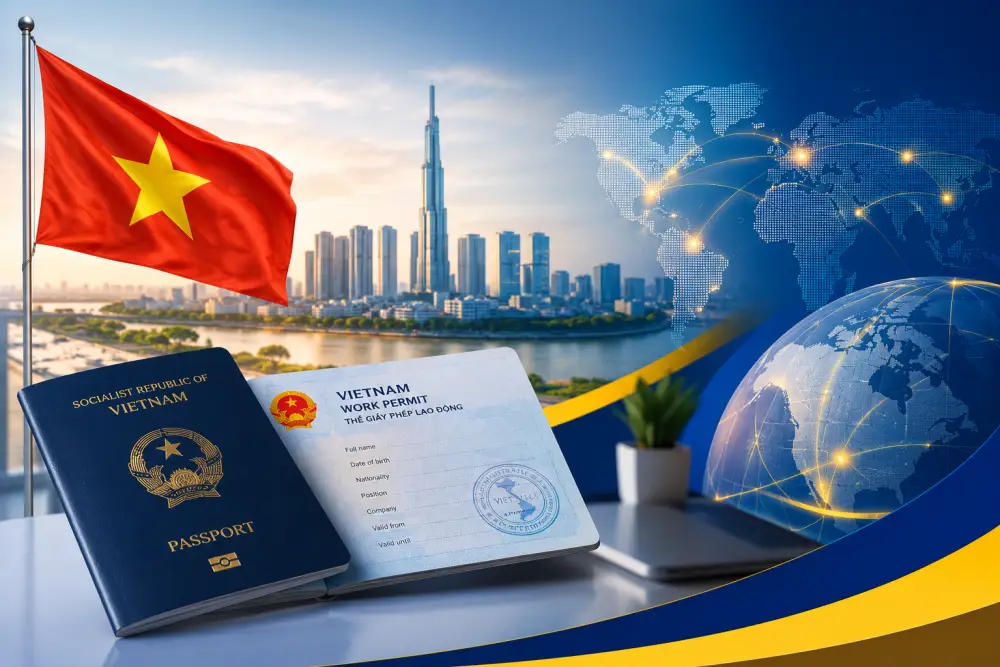
Most foreign nationals who intend to work in Vietnam require a valid work permit before starting employment. The permit is generally linked to a specific employer and position.
Certain categories of workers may qualify for exemptions under Vietnamese law, but exemption eligibility must still be formally assessed and documented.
| Employee Situation | Work Permit Consideration |
|---|---|
| Foreign employee relocating to Vietnam | Usually required |
| Certain exempt categories | May qualify for exemption |
| Vietnamese citizens | Not required |
| Remote employees working outside Vietnam | Depends on employment structure |
Common requirements for foreign employees
Although requirements vary by role and nationality, employers typically need to prepare documentation such as:
- Valid passport
- Educational qualifications
- Professional experience records
- Medical examination
- Criminal background documentation (where applicable)
- Employment offer or labor contract
Preparing documentation early can significantly reduce onboarding delays.
Immigration and employment should work together
Work authorization and employment compliance are closely connected. Employers hiring foreign employees should coordinate:
- Employment contracts
- Visa requirements
- Work permit applications
- Payroll registration
- Social security obligations where applicable
Managing these requirements together creates a smoother hiring process.
When an Employer of Record simplifies international hiring
International companies often use an Employer of Record when hiring foreign employees because the EOR can support employment administration while coordinating local compliance requirements.
This approach is especially useful when businesses need expertise in Vietnam without immediately establishing their own legal entity.
Payroll and Tax Responsibilities When Hiring Employees
Once an employee joins your team, payroll becomes an ongoing compliance responsibility. Employers must ensure salaries are paid accurately, statutory deductions are calculated correctly, and reporting obligations are completed on time.
Efficient payroll in Vietnam helps protect both the employer and employee while reducing administrative risk.
What payroll typically includes
Payroll administration involves much more than processing monthly salary payments.
A compliant payroll process may include:
- Monthly salary calculations
- Personal income tax withholding
- Social insurance deductions
- Health insurance contributions
- Unemployment insurance contributions
- Employer contributions
- Payroll reporting
- Recordkeeping
Employer payroll responsibilities
| Responsibility | Typical Employer Obligation |
|---|---|
| Employee salary | Process accurate monthly salary |
| Personal income tax | Withhold and remit where required |
| Social insurance | Register and contribute for eligible employees |
| Health insurance | Calculate statutory contributions |
| Unemployment insurance | Administer required payments |
| Payroll reporting | Complete ongoing reporting obligations |
Understanding employer contributions
Employers in Vietnam are required to contribute toward several statutory programs for eligible employees. These employer contributions are separate from employee deductions and form part of the overall employment cost.
Businesses should factor these obligations into workforce planning rather than focusing solely on an employee’s salary.
Paying employees accurately and on time
Employees must be paid according to the terms outlined in their labor contract. Accurate payroll processing helps:
- Maintain employee trust
- Reduce payroll disputes
- Support labor law compliance
- Avoid unnecessary penalties
Businesses planning to hire and pay employees across multiple countries often benefit from standardized global payroll processes.
Employee Benefits and Statutory Entitlements
Competitive benefits help businesses attract and retain skilled professionals while meeting mandatory employment obligations. Some benefits are required under Vietnamese labor law, while others are commonly offered to remain competitive in the local market.
Understanding the difference allows employers to design attractive compensation packages without overlooking statutory requirements.
Mandatory employee benefits
Eligible Vietnamese employees are generally entitled to statutory benefits that support healthcare, retirement, and income protection.
These commonly include:
- Social insurance
- Health insurance
- Unemployment insurance
- Paid annual leave
- Public holidays
- Sick leave
- Maternity leave
Common market benefits
In addition to statutory entitlements, many employers provide additional benefits for employees, particularly when competing for top talent.
| Benefit | Mandatory | Typical Practice |
|---|---|---|
| Social insurance | Yes | Required for eligible employees |
| Health insurance | Yes | Required |
| Unemployment insurance | Yes | Required |
| Annual leave | Yes | Statutory entitlement or more |
| Public holidays | Yes | Paid leave |
| Sick leave | Yes | Subject to statutory rules |
| Maternity leave | Yes | Managed through the social insurance system |
| 13th-month salary | No | Widely offered |
| Tet bonus | No | Common before Lunar New Year |
| Private health insurance | No | Frequently offered by multinational employers |
| Professional development | No | Common for skilled roles |
| Flexible work arrangements | No | Increasingly available |
Designing competitive employee packages
Benefits vary depending on industry, seniority, and company culture. Common practice in Vietnam often includes performance bonuses, learning opportunities, wellness programs, and flexible work policies alongside statutory benefits.
Offering a well-rounded package helps employers attract and retain experienced professionals in competitive sectors.
Managing Employees in Vietnam After Hiring
Hiring is only the beginning of the employment relationship. Ongoing HR management helps maintain compliance, improve employee engagement, and support long-term business growth.
Employers should establish clear processes for communication, performance management, and workforce development from the outset.
Focus on the entire employee lifecycle
Effective HR management includes:
- Employee onboarding
- Performance reviews
- Training and development
- Leave management
- Payroll administration
- Policy updates
- Employee relations
Strong HR processes benefit both employers and Vietnamese employees throughout their employment.
Supporting remote and hybrid teams
Many international businesses now manage Vietnamese remote employees across distributed teams.
Successful remote workforce management depends on:
- Clear communication
- Regular performance check-ins
- Secure technology
- Well-defined expectations
- Consistent HR policies
Performance management
Rather than relying only on annual reviews, employers should encourage continuous feedback and measurable performance goals.
This approach supports employee development while strengthening collaboration between employer and employee.
Legal Compliance Checklist Before Hiring
Hiring employees in Vietnam requires careful preparation. Completing a compliance review before recruitment begins helps employers avoid common mistakes and reduces legal risk throughout the employment relationship.
The following checklist provides a practical starting point.
Pre-hiring compliance checklist
Before hiring, confirm that you have:
- Determined the appropriate hiring structure
- Reviewed applicable labor laws in Vietnam
- Classified workers correctly as employees or independent contractors
- Prepared compliant employment contracts
- Established payroll processes
- Planned social insurance registration
- Reviewed tax obligations
- Developed onboarding procedures
- Confirmed work authorization requirements for foreign employees
Common compliance risks
| Risk Area | Why It Matters |
|---|---|
| Incorrect worker classification | Can create employment and tax liabilities |
| Non-compliant employment contracts | May increase legal disputes |
| Payroll errors | Can result in penalties and employee dissatisfaction |
| Missed statutory contributions | May trigger regulatory action |
| Inadequate HR documentation | Makes compliance more difficult |
| Failure to monitor regulatory updates | Labor laws continue to evolve |
When expert support makes sense
Businesses entering Vietnam for the first time often work with local HR specialists or Employer of Record providers to reduce administrative complexity and maintain compliance as regulations evolve.
Professional support becomes especially valuable for companies operating in Vietnam without an established local HR team.
Ready to Hire Employees in Vietnam?
Hiring employees in Vietnam offers exciting opportunities for international businesses, but success depends on choosing the right hiring model, understanding local employment requirements, and maintaining compliance throughout the employee lifecycle.
Some of the most important points to remember include:
- Hire employees using a structure that matches your expansion goals and workforce size.
- Prepare compliant employment contracts before onboarding begins.
- Follow Vietnamese labor law for payroll, taxes, social insurance, and employee entitlements.
- Understand additional work permit and immigration requirements when hiring foreign employees.
- Build strong HR processes to support employee engagement and long-term compliance.
- Consider scalable hiring solutions if you’re expanding across multiple countries.
- Review legal obligations regularly as employment regulations continue to evolve.
Whether you’re hiring your first employee in Vietnam, expanding remote teams, or managing international growth, Empleyo helps simplify global employment. From Employer of Record (EOR) services and global payroll to international hiring, visa and mobility support, and ongoing HR compliance, we provide practical solutions that help businesses expand with confidence. Visit the Empleyo homepage or contact our team today to discuss the best approach for hiring and managing employees in Vietnam.